
If You're Planning Black Friday in November, You're Already Late

Every year, businesses wait until November to start thinking about Black Friday.
Someone decides on the discount. Someone opens Canva. Paid media gets a bigger budget. Email campaigns start going out more frequently. Suddenly, everyone acts like the campaign has officially begun because the graphics are finished.
That is exactly backwards.
Black Friday 2026 falls on November 27, followed by Cyber Monday on November 30. The brands positioned to make the most of those dates are already building their strategy now.
According to Shopify's holiday research, 26% of shoppers planned to begin holiday shopping before the end of September. Demand is already forming while many businesses are still treating Q4 like something that begins after Halloween.
The better way to approach Black Friday and Cyber Monday (BFCM) is not as a sale. It is a 60-day acquisition, conversion, and retention system.
September and October build the machine. November warms the audience and scales what works. December determines whether the customers you paid to acquire were actually worth acquiring.
Black Friday is the moment your strategy gets tested. Not the moment you start building it.
Phase One: Fix the Machine Before You Buy More Traffic

Before increasing paid media spend or announcing a discount, audit the entire customer journey from first impression to completed purchase.
Start with the mobile experience.
Can visitors understand your offer within seconds? Are your product and service pages complete? Is checkout intuitive? Are forms functioning properly? Are reviews, testimonials, and trust signals easy to find? Are shipping policies, returns, availability, and payment options clearly communicated?
Most importantly, is conversion tracking accurate?
If the answer to any of these questions is no, sending more traffic will not solve the problem. It will simply make the problem more expensive.
A weak mobile experience does not improve because your offer is 30% off. A broken checkout does not care that CPMs are rising. A product page missing essential information will continue leaking revenue, even when traffic triples.
Your owned channels deserve the same attention.
Welcome sequences, browse abandonment, cart abandonment, checkout abandonment, post-purchase, win-back, and SMS automations should be operational before peak season begins.
A holiday campaign should never depend entirely on scheduled promotional blasts. Your marketing infrastructure should be recovering abandoned revenue, nurturing prospects, and converting demand even when your team is offline.
Tracking must also be verified before spend increases. Meta, Google, GA4, your ecommerce platform, and your CRM or POS should be connected well enough to support decisions based on actual business outcomes.
Cyber Week is not the time to discover that your conversion event has been inaccurate for six months.
The objective: Build a customer journey that can convert the demand your marketing creates.
Phase Two: Build Demand Before Everyone Is Bidding for It

October is your list-building month.
Grow your email and SMS audiences. Build retargeting pools. Begin prospecting before the most competitive weeks. Seed creator partnerships. Publish gift guides and founder-led content. Capture search demand. Create early-access lists.
Segment existing customers into meaningful groups:
VIP and high-value customers
Repeat purchasers
Lapsed customers
Category-specific buyers
Highly engaged subscribers
First-time customers
The objective is simple: arrive in November with an audience that already knows your brand.
Waiting until Black Friday to acquire cold traffic puts your business into the most competitive environment of the season without the advantage of an existing relationship.
Early acquisition gives you time to educate, retarget, and understand which messages actually influence buying decisions before advertising costs and competition intensify.
It also gives your creative team time to identify which concepts deserve additional investment instead of producing twenty cosmetic variations of the same ad.
Price is one buying argument. Convenience is another. Gifting, scarcity, social proof, founder authority, best sellers, and problem-solution messaging each give customers a different reason to act.
Test the reason people buy, not just the background color of the ad.
Phase Three: Test the Offer Instead of Guessing

Black Friday does not automatically mean 40% off everything.
Klaviyo's BFCM analysis found that average discounts declined from 29.1% to 26.2%, while brands offering the lowest discounts in its analysis recorded the strongest growth.
The takeaway is not that discounts no longer work. It is that relevance, loyalty, exclusivity, and offer structure deserve as much attention as the percentage off.
Consider testing:
Bundles that increase average order value
Spend thresholds that encourage larger purchases
Gifts with purchase
Early access for VIP customers
Selective product markdowns
Free-shipping thresholds
Prepaid packages or limited memberships for service businesses
Gift cards and value-added bonuses
The right offer depends on your margins, capacity, inventory, customer behavior, and what you want the customer to do next.
Offer testing should happen before the most expensive part of the season.
If a bundle is confusing in October, it will not become clearer because the calendar says Black Friday. If a landing page struggles to convert warm traffic now, do not assume Cyber Week urgency will magically fix it.
Your offer should be compelling before the countdown begins.
Phase Four: November Is for Warming and Scaling, Not Inventing

By early November, the major decisions should already be made.
Your business should have a confirmed offer, defined audience segments, tested landing pages, creative directions, an email and SMS calendar, paid-media budget ranges, inventory or service capacity, shipping deadlines, and a clear escalation plan.
November is when you begin increasing pressure deliberately.
Use teasers, wishlists, VIP access, and early announcements to build anticipation. Retarget product viewers and engaged audiences. Publish gift guides. Give existing customers a reason to pay attention before the public promotion begins.
Increase email and SMS frequency intelligently rather than going from near silence to six messages in forty-eight hours.
Your audience should experience a deliberate progression from awareness to anticipation to action.
The key is to treat Cyber Week as the scaling phase.
You are investing more money and attention behind campaigns that have already demonstrated signs of working. You are not holding a strategy meeting on Thanksgiving night because the first ad failed to hit an arbitrary ROAS target.
November should amplify your preparation, not expose your lack of it.
Phase Five: Treat Cyber Week as Multiple Moments

Black Friday, the weekend, and Cyber Monday are not one identical promotional block.
Customer urgency changes. Inventory changes. Creative fatigue changes. Competitors adjust their offers. Your messaging should evolve throughout the week.
Build a campaign calendar that gives each moment a clear purpose.
Black Friday: Lead with your primary offer and strongest conversion messaging.
Saturday and Sunday: Maintain momentum with relevant product recommendations, social proof, best sellers, and segmented follow-ups.
Cyber Monday: Introduce a distinct reason to act, whether that is a final opportunity, a digital offer, or a relevant extension of the promotion.
Throughout the week, monitor:
Conversion rate
Average order value
Contribution margin
Inventory and service capacity
Checkout performance
Customer service issues
Paid-media efficiency
Email and SMS revenue
Scale proven creative and audiences without panicking over every six-hour performance window.
Use urgency honestly. If an offer ends, let it end.
Training customers to believe every deadline is fake destroys the trust you need for the next campaign.
Phase Six: December Is Where Most Brands Leave Money on the Table

The promotion ends. The customer relationship does not.
If you invested in holiday acquisition to bring in thousands of first-time buyers but have no plan for the second purchase, you effectively rented customers for one transaction.
December is where retention becomes a growth strategy.
Post-purchase flows should educate customers and introduce relevant complementary products. Review and referral requests should be timed around the actual customer experience. Replenishable products need replenishment logic. Gift buyers and self-purchasers may require different follow-up journeys.
Shipping cutoffs, gift cards, and digital products can also extend holiday demand after physical delivery windows become restrictive.
According to Klaviyo's BFCM data, email and SMS drove 42% of gross merchandise value across the brands in its analysis.
That reinforces an important point: owned channels are not a side project during the holiday season. They are the infrastructure that allows a business to monetize demand without paying to reacquire the same attention every time.
The work does not end when the order is placed.
It continues through onboarding, customer experience, repeat purchase, referrals, and long-term loyalty.
The real opportunity is not simply acquiring more customers. It is creating more value from every customer you acquire.
The Real Black Friday KPI Is Not the Screenshot

Revenue matters. Profit matters more.
New-customer acquisition matters. Repeat purchase matters more than most BFCM dashboards acknowledge.
The strongest holiday strategy is not necessarily the one that produces the biggest four-day revenue spike at any cost.
It is the one that creates profitable demand, converts it efficiently, and leaves the business with a larger, more valuable customer base afterward.
So stop planning Black Friday like a four-day sale.
Fix the machine now. Build your audience in October. Test your offer before November.
Warm the market before Cyber Week. Scale what works.
And have a December retention plan before the first order comes in.
Black Friday is not the strategy. It is the moment the strategy gets tested.
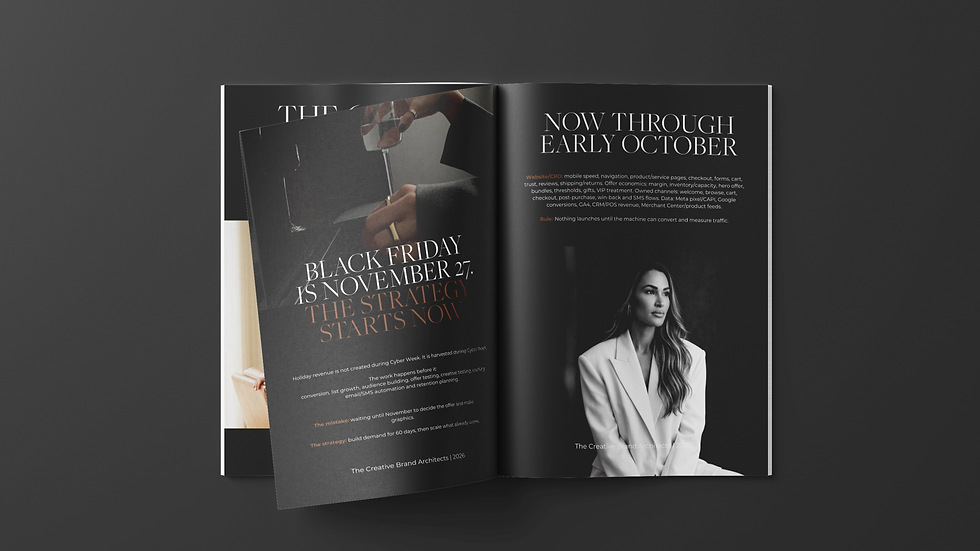
Your website, CRO, email and SMS, paid media, content, and retention strategy should operate as one connected growth system before the holiday rush begins.
If your business needs a clear plan to prepare, convert, and retain customers this BFCM, let's build it before the competition gets louder.
Book a Holiday Growth Strategy Call with The Creative Brand Architects.
Big hugs,


Comments